
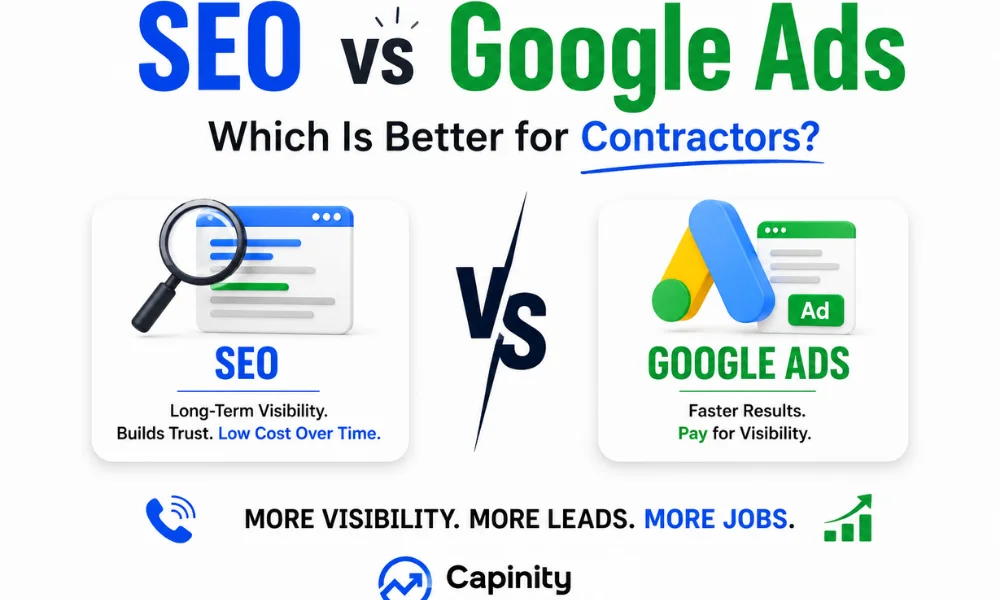
SEO vs Google Ads for Contractors: Which One Should You Choose?
Contractors need a steady flow of calls, quote requests, and booked jobs. But when it comes to online marketing, one question comes up again and again:
Should contractors invest in SEO or Google Ads?
The answer depends on your goals.
Google Ads can help contractors get visibility faster, while SEO builds long-term organic visibility and local authority. For many contractors, the strongest strategy is to use both.
Google Ads can help generate immediate opportunities when you need leads now. SEO can build a long-term source of traffic and visibility that doesn’t depend entirely on paying for every click.
But there’s another piece contractors often overlook:
Getting traffic is only half the job.
If a potential customer calls and nobody answers, a website inquiry sits untouched, or a quote request never gets a follow-up, even a great SEO or Google Ads campaign can lose the opportunity.
That’s why the best contractor marketing strategy connects visibility, trust, lead response, follow-up, and booking.
SEO or Google Ads for Contractors?
SEO is generally better for long-term growth, organic visibility, local authority, and reducing dependence on paid traffic.
Google Ads is generally better when you need faster visibility and have a budget for paid campaigns.
For a new contractor, Google Ads can provide immediate visibility while SEO is being built.
For a growing contractor, using both can create a stronger marketing system.
For an established contractor, SEO and Google Maps visibility can become the foundation, while Google Ads can be used strategically for high-value, emergency, or seasonal services.
SEO vs. Google Ads at a glance
Factor | SEO | Google Ads |
Speed | Slower | Faster |
Cost model | Ongoing investment | Ongoing ad spend |
Long-term value | High | Depends on continued spend |
Google Maps visibility | Important | Available through eligible paid formats |
Best for | Long-term growth | Faster lead generation |
Main challenge | Takes time | Can become expensive |
Best use | Build visibility and authority | Capture immediate demand |
The right choice depends on your market, competition, budget, service area, average job value, website, reviews, and ability to respond to leads.
What Is SEO for Contractors?
SEO, or search engine optimization, is the process of improving your website and online presence so your business can appear when potential customers search for your services.
A homeowner might search:
- HVAC repair near me
- Emergency plumber near me
- Roofing contractor in Dallas
- Bathroom remodeling contractor in Chicago
- Electrician near me
Contractor SEO isn’t just about publishing blog posts.
A strong local SEO strategy can include:
- Google Business Profile optimization
- Service pages
- Location pages
- Local keyword research
- On-page SEO
- Technical SEO
- Review strategy
- Local citations
- Internal linking
- Backlinks
- Schema markup
- Helpful local content
Google says local results are primarily influenced by relevance, distance, and prominence. Google also notes that reviews and positive ratings can contribute to local ranking.
That makes local SEO especially important for contractors competing for customers in specific cities and service areas.
What Are Google Ads for Contractors?
Google Ads allows contractors to pay for visibility when potential customers search for relevant services.
Instead of waiting for an organic ranking to develop, you can create campaigns around services such as:
- Emergency plumbing
- Water heater repair
- Drain cleaning
- Roof repair
- Roof replacement
- AC repair
- HVAC installation
- Electrical panel upgrades
- Kitchen remodeling
This can be especially useful when customers have strong purchase intent.
For example, someone searching “emergency plumber near me” is probably much closer to contacting a business than someone reading a general article about plumbing problems.
Google also offers pay-per-lead advertising for eligible local service businesses. Google is currently transitioning Local Services Ads into a more integrated Performance Max experience with pay-per-lead goals. The pay-per-lead model remains, and eligible ads continue to appear on Google Search and Google Maps.
SEO vs Google Ads: What’s the Main Difference?
The simplest way to think about it is:
SEO builds visibility.
Google Ads buys visibility.
SEO can help your website, Google Business Profile, and other online assets become more visible over time.
Google Ads can put your business in front of potential customers much faster, but the visibility depends on your advertising budget and campaign performance.
That creates an important difference:
SEO is a long-term asset. Google Ads is an ongoing traffic acquisition channel.
That doesn’t mean one is automatically better.
It means they solve different problems.
Benefits of SEO for Contractors
1. SEO Builds Long-Term Visibility
When your contractor website ranks for valuable local searches, it can continue generating organic traffic without paying for every individual click.
For example, an HVAC service page targeting “AC repair in [city]” can continue attracting relevant visitors after the page has earned visibility.
The same applies to local search and Google Maps visibility.
SEO takes time to build, but strong rankings and useful content can continue producing value over the long term.
2. SEO Builds Trust
Homeowners often compare several contractors before choosing one.
They may look at:
- Reviews
- Star ratings
- Photos
- Services
- Website quality
- Business information
- Experience
- Location
- Contact options
Reviews are particularly important.
BrightLocal’s 2026 Local Consumer Review Survey reports that 31% of consumers will only use a business with 4.5 stars or higher, 47% won’t use a business with fewer than 20 reviews, and 74% only care about reviews written within the last three months.
For contractors, trust matters because customers are often inviting the business into their home and trusting them with an expensive problem.
3. SEO Supports Google Maps Visibility
For many contractors, Google Maps is just as important as traditional organic search.
Customers may search for a service, compare several local businesses, read reviews, and call directly from the results.
Local SEO can help strengthen the signals around your:
- Google Business Profile
- Business category
- Service information
- Service areas
- Reviews
- Photos
- Website
- Local citations
- Service pages
- Location pages
Google says local ranking is based mainly on relevance, distance, and prominence, with reviews and links among the information that can contribute to prominence.
4. SEO Can Reduce Dependence on Paid Traffic
Google Ads requires ongoing advertising spend.
SEO also requires investment, but the value can continue after a page has earned organic visibility.
That doesn’t mean SEO is free.
You may still need to invest in:
- Content
- Technical improvements
- Local SEO
- Reviews
- Link building
- Website improvements
- Ongoing optimization
But over time, strong organic visibility can reduce your dependence on paid clicks.
5. SEO Improves Your Website
Good SEO isn’t just about rankings.
It also encourages you to build a better website for customers.
A contractor website should clearly explain:
- What services you offer
- Where you work
- Why customers should trust you
- How to contact you
- How to request an estimate
- What makes your company different
A fast, mobile-friendly, easy-to-navigate website can help both search engines and customers understand your business.
Downsides of SEO for Contractors
The biggest problem with SEO is simple:
It takes time.
A contractor operating in a competitive market may need months of consistent work before seeing significant organic growth.
Google Business Profile improvements can sometimes show progress sooner, but building website authority, content depth, rankings, and local visibility generally requires ongoing effort.
SEO also fails when it’s approached as a one-time project.
Publishing a few generic blog posts isn’t enough.
Contractors may need:
- Strong service pages
- Location pages
- Reviews
- Technical improvements
- Internal links
- Local content
- Citations
- Authority-building
- Ongoing optimization
Poor SEO can also create problems when businesses rely on keyword stuffing, duplicate location pages, weak content, or generic pages.
Benefits of Google Ads for Contractors
1. Google Ads Can Produce Visibility Faster
This is the biggest advantage.
If your campaign is properly set up, your business can begin appearing for relevant searches much faster than it would through organic SEO.
Google Ads can be useful when:
- You’re a new contractor
- You need leads quickly
- You’re launching a new service
- You’re entering a new market
- You offer emergency services
- You want seasonal leads
- You want to test demand
However, fast visibility doesn’t automatically mean profitable results.
You still need good targeting, landing pages, conversion tracking, and lead handling.
2. You Can Focus on High-Value Services
Contractors don’t necessarily want every possible lead.
They want the right leads.
For example, a roofing company may prioritize:
- Roof replacement
- Storm damage
- Commercial roofing
- Roof repair
An HVAC company may prioritize:
- AC replacement
- HVAC installation
- Emergency repair
- Furnace replacement
Focusing your campaigns on high-value services can help you put your budget toward opportunities that make financial sense.
3. You Can Control Budget and Location
Contractors usually operate within specific service areas.
Google Ads allows businesses to set campaign budgets and targeting parameters so they can focus on the locations and services that matter to them.
This is important when you don’t want to spend money attracting customers outside your service area.
4. Ads Can Help New Businesses
A new contractor may have a good website but very little organic authority.
SEO takes time.
Google Ads can help fill that gap while the business builds:
- Google Business Profile strength
- Reviews
- Service pages
- Local authority
- Organic rankings
This makes paid search particularly useful during the early stages of a business.
5. Ads Can Support Seasonal Demand
Many contractor services experience seasonal demand.
Examples include:
- AC repair during summer
- Heating repair during winter
- Roof repair after storms
- Gutter cleaning during rainy seasons
- Pest control during warmer months
Paid campaigns can help contractors increase visibility when demand for a particular service rises.
Downsides of Google Ads for Contractors
Google Ads can generate excellent leads, but poor campaign management can quickly become expensive.
Common problems include:
- Poor keyword targeting
- Broad or irrelevant traffic
- Weak landing pages
- No call tracking
- No conversion tracking
- Poor location targeting
- Low-quality leads
- Slow response times
- No follow-up system
- High competition
The biggest difference from SEO is simple:
When you stop paying for the campaign, the paid visibility stops.
That makes it risky to depend entirely on paid traffic for long-term growth.
SEO vs Google Ads: Which Is Faster?
Google Ads is generally faster.
A properly configured campaign can start generating visibility much sooner than a new website can build strong organic rankings.
But there’s an important catch:
Fast traffic isn’t the same as profitable leads.
A contractor still needs:
- Good targeting
- Relevant ad copy
- Strong landing pages
- Conversion tracking
- Call tracking
- Fast response
- Follow-up
- A clear booking process
If someone clicks your ad and calls but nobody answers, the advertising spend may produce little value.
That’s why lead response needs to be considered alongside your marketing strategy.
SEO vs Google Ads: Which Is Better for Long-Term Growth?
For long-term visibility, SEO generally has the advantage.
A strong SEO strategy can create opportunities across:
- Service searches
- Location searches
- Google Maps
- Informational searches
- Comparison searches
- Long-tail searches
- AI-assisted search experiences
For example, a contractor could potentially build visibility around searches such as:
- How much does roof repair cost?
- When should I replace my HVAC system?
- Best plumber near me
- Emergency electrician in [city]
- Bathroom remodeling contractor in [city]
This allows the business to reach customers at different stages of the buying journey.
SEO vs Google Ads: Which Costs More?
This is where many contractors make the wrong comparison.
SEO and Google Ads have different cost structures.
SEO costs can include:
- SEO strategy
- Website optimization
- Content
- Local SEO
- Technical SEO
- Reviews
- Citations
- Link building
- Ongoing maintenance
You’re investing in building an asset that can continue generating organic visibility.
Google Ads costs can include:
- Ad spend
- Campaign management
- Landing pages
- Conversion tracking
- Call tracking
- Creative and copy
- Ongoing optimization
With standard Google Ads, you’re generally paying for clicks or other campaign-specific interactions. Eligible pay-per-lead local campaigns use a different model in which you pay for valid customer connections rather than standard ad clicks.
So don’t ask only:
“Which one is cheaper?”
Ask:
“Which channel produces profitable booked jobs for my business?”
SEO vs Google Ads by Business Stage
New Contractor
A new contractor often needs visibility quickly.
A practical approach is:
- Google Business Profile setup
- Core service pages
- Main location pages
- Review collection
- Basic local SEO
- A focused Google Ads campaign
- Call tracking
- Fast lead response
Google Ads can provide immediate visibility while SEO is being developed.
Growing Contractor
A growing contractor will often benefit from using both.
Google Ads can target high-value services while SEO builds organic visibility and local authority.
Focus on:
- Service pages
- Location pages
- Google Business Profile
- Reviews
- Local content
- Technical SEO
- Conversion optimization
- Lead tracking
- Follow-up automation
Established Contractor
An established contractor can use SEO as the long-term foundation and Google Ads strategically.
Ads may be especially useful for:
- Emergency services
- Seasonal campaigns
- High-value services
- Competitive searches
- New service areas
At this stage, the goal should be to build a strong organic presence while using paid campaigns where they make financial sense.
When Should Contractors Choose SEO?
SEO should be a priority if:
- You want long-term growth
- You want stronger organic visibility
- You want better Google Maps visibility
- You want to build authority
- You serve multiple locations
- You want to reduce dependence on paid traffic
- You’re willing to invest consistently
- You want your website to become a long-term lead source
SEO is especially valuable when you want customers to find your business month after month rather than only while your ads are running.
When Should Contractors Choose Google Ads?
Google Ads may be the better starting point if:
- You need leads quickly
- You’re launching a new business
- You’re entering a new market
- You have high-value services
- You have a defined advertising budget
- You want seasonal leads
- You want emergency-service leads
- You have a strong landing page
- You can respond quickly
But don’t judge campaigns only by clicks.
Track which campaigns generate qualified leads, estimates, booked jobs, and revenue.
Why SEO and Google Ads Work Better Together
SEO and Google Ads don’t have to compete.
They can support each other.
Google Ads
Gets you faster visibility.
SEO
Builds long-term organic visibility.
Reviews
Build trust.
Google Business Profile
Supports local discovery.
AI automation
Helps respond to and follow up with leads.
Booking
Turns opportunities into estimates and jobs.
This creates a much stronger system than treating traffic generation as the entire marketing strategy.
For example, Google Ads can help you discover which services and search terms produce conversions. Those insights can inform your SEO strategy and service pages.
At the same time, strong SEO can create organic visibility that reduces your dependence on paid traffic over time.
The Missing Piece: Lead Response and Follow-Up
This is where many contractor marketing strategies fall apart.
You can invest in:
SEO → more visibility
Google Ads → more traffic
Reviews → more trust
But what happens when the lead actually contacts you?
Common problems include:
- Missed calls
- Slow replies
- After-hours inquiries
- Forgotten quote requests
- No follow-up
- No easy appointment booking
A homeowner looking for an emergency plumber, HVAC repair, or roofing service may contact multiple businesses.
If one contractor responds immediately and another responds several hours later, the faster response can have a major advantage.
That’s why the goal shouldn’t simply be:
“Get more leads.”
It should be:
“Get found, respond quickly, follow up, and book the job.”
8 Common Marketing Mistakes Contractors Make
1. Running Ads Without Tracking Calls
If you aren’t tracking calls and conversions, you don’t know which campaigns are actually producing business.
2. Sending Paid Traffic to a Weak Homepage
A general homepage may not match the intent behind a specific search.
A dedicated service landing page can provide a more relevant experience.
3. Ignoring SEO While Paying for Ads
Ads can produce immediate visibility, but relying entirely on paid traffic can leave you dependent on advertising spend.
4. Neglecting Your Google Business Profile
Incomplete business information, weak photos, incorrect hours, and ignored reviews can hurt your local presence.
5. Not Building a Review Strategy
Reviews influence trust and can contribute to local prominence.
6. Creating Weak Location Pages
If you serve multiple locations, your website should clearly communicate the areas and services you genuinely serve.
Avoid creating thin, duplicate pages that simply swap city names.
7. Responding Too Slowly
A lead that waits too long may contact a competitor instead.
8. Targeting the Wrong Keywords
Traffic isn’t the goal.
Relevant, high-intent traffic that can become customers is the goal.
The Best Contractor Marketing Strategy
For most contractors, the answer isn’t simply SEO or Google Ads.
It’s a connected system.
SEO
Helps customers find you organically.
Google Ads
Helps you capture immediate demand.
Google Business Profile
Supports local visibility.
Reviews
Build customer trust.
AI automation
Helps respond to inquiries and missed calls.
Follow-up
Keeps opportunities from going cold.
Booking
Turns leads into estimates and jobs.
The result is a marketing system focused on revenue rather than vanity metrics.
How Capinity Helps Contractors Turn Visibility Into More Opportunities
Capinity helps contractors connect marketing with lead response and follow-up.
Its approach combines local visibility with AI automation to help businesses:
- Improve Local SEO
- Optimize Google Business Profile
- Build service and location pages
- Create SEO-focused content
- Improve visibility across search experiences
- Strengthen review generation
- Track rankings, calls, and leads
- Recover missed calls
- Automate lead follow-up
- Help book more estimates
The important difference is that the process doesn’t stop at getting someone to your website.
The goal is to get found, earn trust, respond quickly, follow up, and help turn opportunities into booked jobs.
SEO or Google Ads?
If your contractor business needs leads right now, Google Ads can provide faster visibility while you build SEO in the background.
If your goal is long-term organic growth, SEO should be a priority.
If your budget allows, use both strategically.
The strongest approach is often:
SEO → Get found
Google Ads → Capture immediate demand
Reviews → Build trust
AI automation → Respond faster
Follow-up → Keep leads engaged
Booking → Turn opportunities into jobs
For contractors, the real goal isn’t simply more website traffic.
It’s getting found, earning trust, responding quickly, and booking more work.
Frequently Asked Questions
Is SEO better than Google Ads for contractors?
SEO is generally better for long-term organic visibility and reducing dependence on paid traffic. Google Ads is generally better for faster visibility and immediate lead-generation opportunities. Many contractors benefit from using both.
How long does SEO take for contractors?
SEO can take several months to produce strong results, depending on competition, website quality, local authority, reviews, content, and the existing strength of the business. Some Google Business Profile improvements may appear sooner, but sustainable organic growth generally requires consistent work.
Are Google Ads worth it for contractors?
Google Ads can be worthwhile when campaigns are properly targeted, conversions are tracked, landing pages are relevant, and leads are handled quickly. Poor targeting and weak follow-up can reduce profitability.
Should a new contractor use SEO or Google Ads first?
A new contractor can use Google Ads for faster visibility while building SEO at the same time. A strong foundation should include Google Business Profile optimization, core service pages, reviews, local SEO, and a focused paid campaign.
Why do contractors waste money on Google Ads?
Common problems include poor targeting, irrelevant traffic, weak landing pages, no call tracking, poor conversion tracking, slow responses, and no follow-up process.
Can SEO reduce Google Ads costs over time?
SEO can reduce dependence on paid traffic by building organic visibility and generating leads without paying for every organic visit. It doesn’t necessarily eliminate the need for advertising, but it can make the overall marketing mix less dependent on paid traffic.
What is the best marketing strategy for contractors?
A strong contractor marketing strategy usually combines Local SEO, Google Business Profile optimization, reviews, service pages, location pages, Google Ads when appropriate, and fast lead follow-up. AI automation can help businesses respond to and manage leads from multiple acquisition channels.
Should contractors focus on SEO or Google Ads if they have a limited budget?
If immediate lead flow is the priority, a focused paid campaign may make sense. If the business can wait and invest consistently, SEO can build longer-term value. In either case, the budget should be tied to measurable outcomes such as qualified leads, estimates, booked jobs, and revenue.
Key Takeaway
SEO and Google Ads both work for contractors but they solve different problems.
Google Ads helps you get visibility faster.
SEO helps you build long-term visibility.
Reviews help customers trust you.
AI automation helps you respond faster.
Follow-up helps turn opportunities into booked jobs.
The best contractor marketing strategy isn’t simply about getting more traffic.
It’s about getting found, earning trust, responding quickly, and turning more opportunities into real business.