
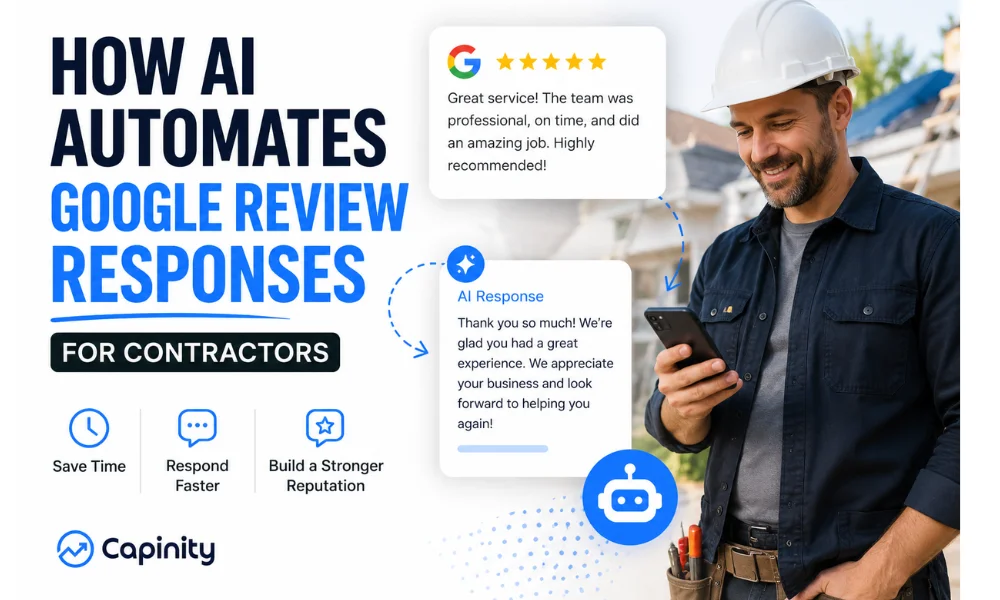
If you run a contracting business, you already know how quickly the day disappears.
You’re meeting customers, preparing estimates, managing crews, answering calls, and dealing with jobs that rarely go exactly according to schedule.
Then a new Google review comes in.
You know you should respond. But finding the time to write a thoughtful response to every review can be difficult.
That’s where AI review response automation can help.
Instead of manually checking Google, deciding what to say, and writing every response from scratch, AI can analyze new reviews, create personalized responses, and help you manage them at scale.
The key is using automation intelligently.
AI should handle the repetitive work while your team stays in control of sensitive customer conversations.
Why Contractors Struggle to Keep Up With Google Reviews
Reviews are important, but responding to them usually isn’t a contractor’s top priority.
When you’re running a roofing, HVAC, plumbing, electrical, landscaping, or general contracting business, your attention is usually focused on the next job.
A review can easily become:
“I’ll respond to that later.”
And later often never comes.
The problem gets bigger as your business grows. Ten reviews a month might be manageable. Fifty or one hundred reviews require a much more consistent process.
This is where automation can make a difference.
Instead of relying on someone to remember to check reviews every day, an automated system can monitor incoming reviews and help determine what should happen next.
Why Responding to Google Reviews Matters
A review is more than feedback from an existing customer.
It’s also something a potential customer may read while deciding whether to contact your business.
A professional response can show that your company:
- Pays attention to customer feedback
- Appreciates its customers
- Takes complaints seriously
- Communicates professionally
- Is actively engaged with its customers
You don’t need a long response to every review.
In many cases, a short, genuine response is better than a paragraph of generic marketing language.
The goal isn’t to make every response sound like it was written by a marketing department.
The goal is to make customers feel heard.
What Is AI Review Response Automation?
AI review response automation uses artificial intelligence to help businesses manage and respond to customer reviews.
A typical workflow looks like this:
New review → AI analyzes the review → AI identifies the sentiment → AI creates a response → response is approved or automatically published → system tracks the interaction
The AI can look at the content of the review and determine whether it is positive, mixed, or negative.
It can then create a response that matches your company’s preferred tone.
For example, a roofing company might want responses that are friendly and professional without sounding overly corporate.
The AI can use that brand voice when creating responses.
How AI Automates Review Responses for Contractors
1. A New Review Is Detected
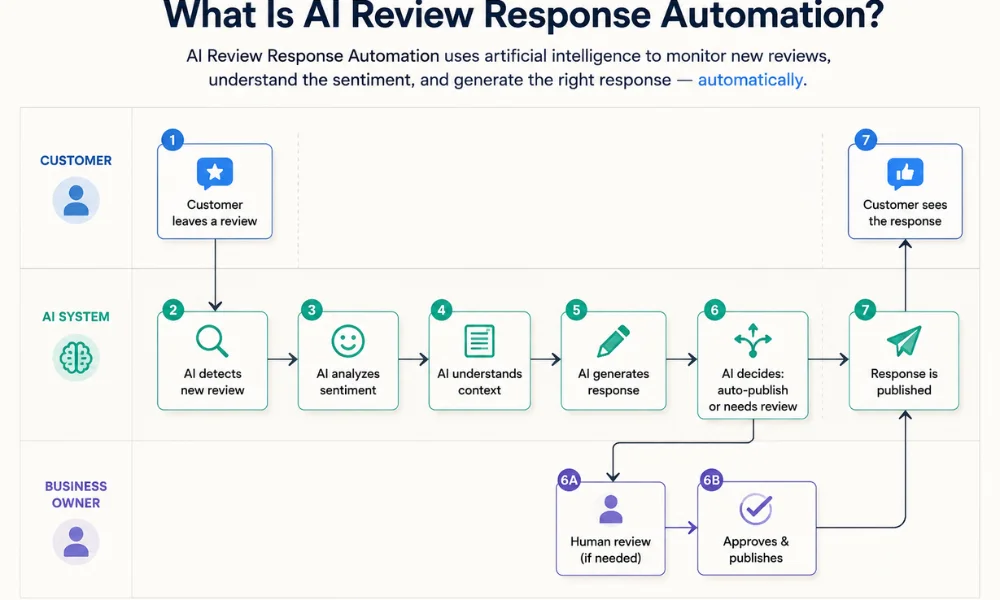
The process starts when a customer leaves a new review.
Instead of relying on someone to manually check for new reviews, an automated system can identify incoming feedback and trigger the next step.
2. AI Analyzes the Review
The AI examines what the customer actually said.
It can identify things such as:
- Positive feedback
- Complaints
- Questions
- Service issues
- Mentions of specific employees or services
- Overall sentiment
This matters because a five-star review shouldn’t receive the same response as a one-star complaint.
3. AI Creates a Personalized Response
The AI can use relevant details from the customer’s review to create a response.
For example, if a customer says:
“The HVAC team arrived on time and explained everything before starting the repair.”
A generic response might say:
“Thank you for your review. We appreciate your business!”
An AI-assisted response could be more specific:
“Thank you for the kind words! We’re glad our HVAC team could arrive on time and explain the repair clearly. We appreciate you trusting us with your home.”
The second response feels more personal because it actually addresses what the customer mentioned.
4. The Response Matches Your Brand Voice
Every contractor has a different personality.
A family-owned plumbing company might want a warm and conversational tone.
A commercial contractor might prefer something more professional.
Your AI workflow should reflect that difference.
You can define guidelines such as:
- Friendly
- Professional
- Concise
- Helpful
- Never defensive
- Avoid excessive emojis
- Don’t use repetitive phrases
- Don’t make claims that aren’t supported by the review
This helps prevent every response from sounding like the same AI-generated template.
5. The System Decides Whether a Human Should Review It
This is one of the most important parts of responsible automation.
Not every review should be automatically published.
A simple system could look like this:
| Review type | Recommended action |
| 5-star positive review | AI can respond automatically |
| 4-star positive review | AI can respond automatically |
| 3-star mixed review | Human approval recommended |
| 1–2 star review | Human approval recommended |
| Serious complaint | Human handling |
| Legal or safety allegation | Human handling |
| Privacy-sensitive issue | Human handling |
This approach gives contractors the best of both worlds.
AI handles repetitive reviews.
Your team handles situations that require judgment.
What Should AI Say to Different Types of Reviews?
The quality of the response matters just as much as the speed.
Example: 5-Star Contractor Review
Customer:
“Great roofing company. They finished the job quickly and cleaned everything up afterward.”
AI-assisted response:
“Thank you for the great review! We’re glad the team could complete the roofing project quickly and leave everything clean. We appreciate you choosing us for the job.”
The response is short, specific, and relevant.
Example: 4-Star Review
Customer:
“The work was excellent, but the project took a little longer than expected.”
The response shouldn’t ignore the criticism.
A better response would acknowledge both sides:
“Thank you for sharing your feedback. We’re glad you were happy with the quality of the work, and we appreciate your patience with the project timeline. We’ll continue working to improve communication and scheduling.”
Example: 3-Star Review
A mixed review deserves more attention.
The customer may have liked the actual work but had an issue with communication, scheduling, pricing, or another part of the experience.
This is a good example of where AI can draft the response but leave the final decision to a human.
Example: 1-Star Review
Negative reviews require even more care.
The goal shouldn’t be to argue with the customer or prove them wrong publicly.
A better approach is to acknowledge the concern and move the detailed conversation into a private channel.
For example:
“We’re sorry to hear that your experience didn’t meet expectations. We take your feedback seriously and would like to understand what happened. Please contact our team directly so we can discuss this with you.”
The exact response should depend on the situation.
Should AI Automatically Respond to Negative Reviews?
Generally, the more serious the review, the more important human oversight becomes.
AI is excellent at repetitive communication.
It’s not a substitute for judgment when a customer is making a serious allegation or describing a complicated dispute.
Contractors should be particularly careful with reviews involving:
- Property damage
- Injuries
- Legal disputes
- Refund disagreements
- Safety concerns
- Privacy issues
- Accusations of misconduct
For these situations, AI can still help by organizing the information or drafting a response, but a person should review it before anything is published.
How to Stop AI Responses From Sounding Robotic
One of the biggest concerns about AI-generated responses is that they can become repetitive.
You’ve probably seen responses like:
“Thank you for your wonderful feedback! We are thrilled to hear that you had an exceptional experience with our team.”
After reading ten of those, they all start to sound the same.
Good AI automation should avoid this.
Use details from the review
If the customer mentions a technician, service, project, or specific part of the experience, the response should acknowledge it when appropriate.
Keep responses concise
A review response doesn’t need to become a sales pitch.
Short and genuine usually works better.
Establish a brand voice
Tell the AI how your company communicates.
For example:
“Write like a friendly local contractor. Keep responses between 30 and 60 words. Be professional but conversational. Never sound corporate or overly enthusiastic.”
Don’t invent information
AI shouldn’t claim that a specific employee worked on a project unless that information is actually known.
It shouldn’t invent discounts, warranties, timelines, or other details.
Avoid keyword stuffing
Don’t turn a customer response into an SEO paragraph filled with phrases like “best roofing contractor in Dallas.”
The response is for the customer first.
AI Review Responses vs. Manual Responses
Manual review management isn’t necessarily bad.
For a small business with a handful of reviews each month, it may be perfectly reasonable.
The challenge is consistency as the business grows.
| Manual responses | AI-assisted responses |
| Written one at a time | Responses can be drafted automatically |
| Depends on someone remembering | New reviews can trigger a workflow |
| Time-consuming at scale | Easier to manage larger review volume |
| Can become repetitive | AI can vary responses |
| Human-controlled | Human approval can remain part of the process |
The best approach isn’t necessarily AI instead of humans.
It’s AI for repetitive work + humans for important decisions.
The Bigger Opportunity: Automating Contractor Communication
Review management is only one part of the customer communication problem.
Think about the entire customer journey:
New lead
↓
Instant response
↓
Job details collected
↓
Estimate scheduled
↓
Follow-up
↓
Job completed
↓
Customer follow-up
↓
Review request
↓
Review response
Every step creates an opportunity for communication to fall through the cracks.
For a busy contractor, that’s a lot to manage manually.
This is where automation becomes much more powerful than simply generating review responses.
How Capinity Helps Contractors Automate Customer Communication
Capinity is built around a simple problem:
Contractors shouldn’t lose opportunities just because they’re busy doing the work.
Instead of forcing contractors to manually manage every customer conversation, Capinity helps automate communication throughout the customer journey.
That can include responding to leads, collecting job information, following up with prospects, helping schedule estimates, and keeping customer communication moving.
Review responses can fit into the same broader communication strategy.
The goal isn’t to replace your team.
It’s to make sure important conversations don’t get forgotten when everyone is busy.
Final Thoughts
Contractors already have enough to manage.
You shouldn’t have to stop what you’re doing every time a customer leaves a Google review.
AI can take care of much of the repetitive work:
Monitor → Analyze → Draft → Respond → Escalate when necessary
But good automation isn’t about removing humans from the process.
It’s about letting AI handle the routine communication while your team focuses on customers, jobs, and the situations where human judgment actually matters.
Your customers are already talking about your business. Make sure you’re part of the conversation.
Want to see how Capinity can help automate customer communication for your contracting business?
Book a demo or get in touch with Capinity to see what you can automate.
Frequently Asked Questions
Can AI respond to Google reviews?
Yes. AI can analyze new reviews and generate responses based on the review content and your preferred brand voice. Businesses can choose to automatically publish certain responses or require human approval.
Can Google review responses be automated?
Review response automation is possible through software and connected workflows. However, businesses should consider keeping human approval for negative, sensitive, or complicated reviews.
Should contractors automate negative review responses?
Negative reviews generally deserve more human oversight. AI can draft a professional response, but a contractor or manager should review it before publishing, especially when the complaint involves serious issues.
Will AI-generated review responses sound robotic?
They can if the system uses generic templates. Better results come from giving AI clear brand guidelines and allowing it to reference relevant details from each review.
Can AI respond to reviews in my company’s brand voice?
Yes. AI can be given instructions about tone, length, vocabulary, and communication style so responses are more consistent with the company’s brand.
Does responding to reviews guarantee better Google rankings?
No. Businesses shouldn’t treat review responses as a guaranteed ranking tactic. The primary goal should be communicating professionally with customers and showing potential customers that the business pays attention to feedback.
Can AI respond to Google reviews?
Yes. AI can analyze a new Google review and generate a relevant response based on the customer’s feedback and your company’s preferred tone. Businesses can use AI to draft responses for approval or, depending on their workflow, automate responses to appropriate reviews.
Google recommends keeping review responses professional, relevant, concise, and conversational. For complicated or negative reviews, businesses should consider moving the conversation to a private channel rather than arguing publicly.
How many 5-star reviews does it take to cancel out a 1-star review?
There isn’t one fixed number because it depends on your current number of reviews and your existing average rating.
For example, if you have 10 five-star reviews and one one-star review, your average becomes:
51 ÷ 11 = 4.64 stars
To reach a 4.9-star average after that one-star review, you’d need approximately 39 additional five-star reviews.
The important takeaway is that one bad review doesn’t permanently define your reputation. Consistently earning genuine positive reviews over time can gradually improve your overall rating.
And don’t try to manufacture those reviews. Google says reviews should reflect genuine customer experiences, and fake or incentivized reviews can violate its policies.
Can AI create Google reviews?
No, AI should not create fake Google reviews.
AI can help a contractor request genuine reviews from real customers, create a review-request message, or make it easier for customers to find the correct Google review link.
But the actual review should come from the customer and reflect their genuine experience. Google prohibits fake engagement, including reviews that don’t represent a real experience or reviews created through prohibited manipulation.
A better use of AI is:
Completed job → customer follow-up → review request → genuine customer review → AI-assisted response
That’s automation without compromising trust.
How does Google AI get answers?
Google’s AI-powered Search features use generative AI together with information from Google Search and the web. Google says AI Mode can break a question into subtopics and search for relevant information, while AI Overviews can provide an AI-generated summary with links to supporting web sources.
This means Google AI isn’t simply pulling an answer from one website. It can use information from multiple sources to construct a response.
However, Google also warns that AI-generated answers can contain mistakes. For important information, users should check the supporting sources and other search results.
For local contractors, this makes accurate, useful, trustworthy online content increasingly important. Your website, services, business information, and customer reviews all contribute to the information potential customers can discover about your company.